
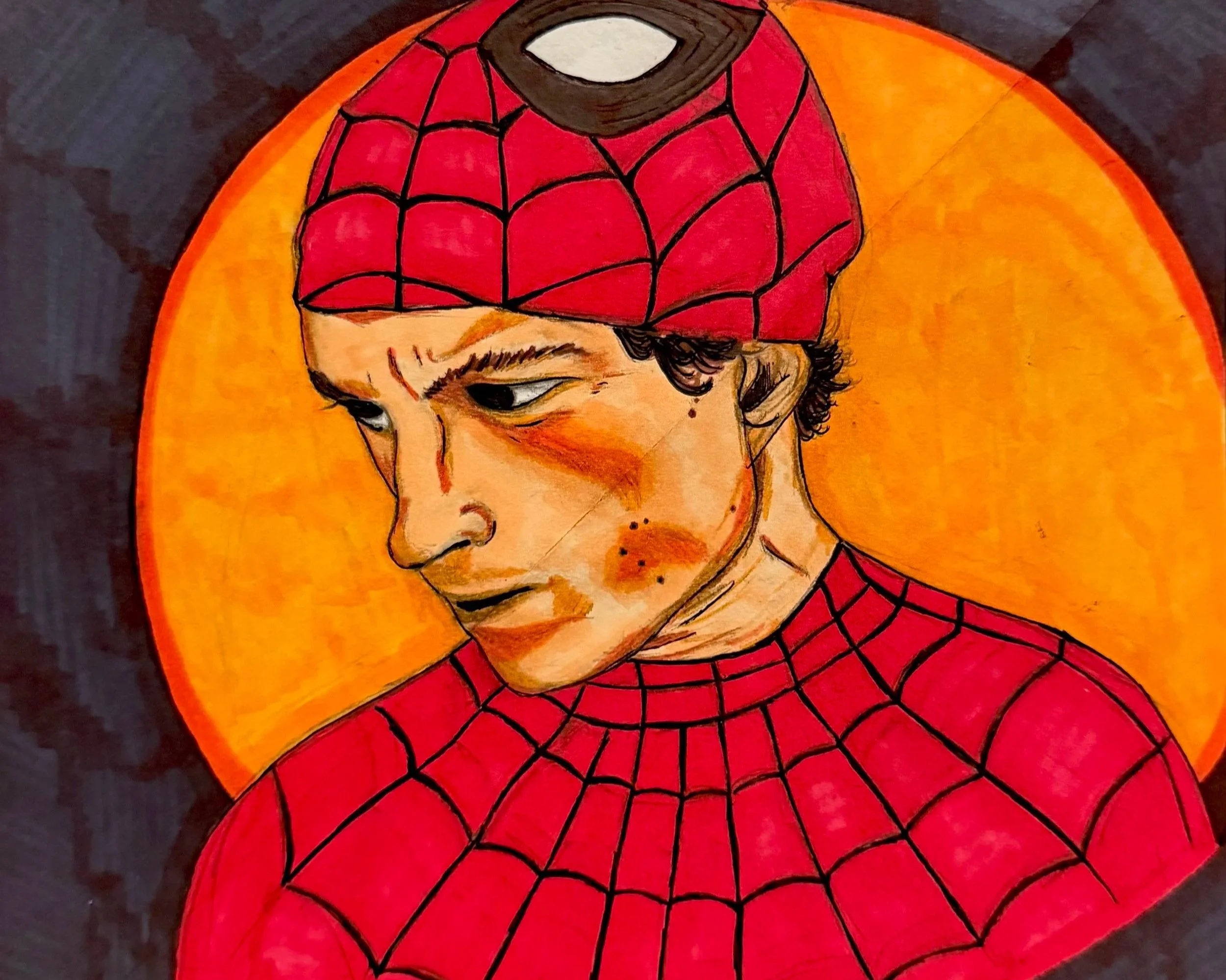
Art by: Jade Safran
The fourth installment of Marvel's Spider-Man franchise, "Spider-Man: Brand New Day," premiered this past July. The movie has since become the highest-grossing film of the year and the third highest-grossing film of all time, scoring high with audiences for its heartfelt performances and emotional character arc. Among the more positive reviews from both audience members and critics, however, the movie has also drawn a number of negative comparisons with previous iterations of Spider-Man (starring Tobey Maguire and Andrew Garfield) in connection with its characterization of such central characters to the Spider-Man canon as Aunt May and MJ (Mary Jane). Audiences were also quick to note the movie's justification of AI as a necessary surveillance tool. Outside of the social and political implications of such creative choices, for many audience members, it has become a question of whether such choices depict Spider-Man in a way that remains faithful to the comics.
Perhaps one of the most controversial aspects of the movie is its characterization (or lack of it) of MJ (played by Zendaya). Though her relationship with Peter Parker (played by Tom Holland) is framed as the movie's emotional core, MJ simply doesn't have the emotional depth needed to support his arc. Much of her dialogue is devoted to portraying her as the anti-manic pixie dream girl; MJ is angsty, witty, and doesn't want to work for large corporations, but this isn't enough to make her much more than a stock character, and it's difficult to empathize with a character who is largely a mystery. As such, when the long awaited reunion between MJ and Peter finally arrives, and she rejects him, it feels less like a tragedy and more like she's stepping out of her assigned role as the love interest, perhaps even betraying viewers' expectations of what little character she has.
But the main character of this movie isn't MJ. It's Spider-Man. And this Spider-Man has become oddly complacent.
The throwback to the Department of Damage Control from “Spider-Man: Homecoming” (2017) is unexpected, but not as unexpected as the willingness with which Spider-Man takes direction from various government representatives. This first becomes apparent when Department Director Metzger (played by Tramell Tillman) reveals that he has integrated The Hand — an organization of ninjas that Spider-Man subdues at the beginning of the film — into the department. He describes The Hand as a misguided "group of kids without a leader," who pose more of an opportunity than a threat. Viewers who are familiar with the comics or have seen the tv show “Daredevil” would know that The Hand is its own fully formed organization with a lengthy, complicated history. So, to refer to the only Asian representation in the movie as a "group of kids without a leader" feels reductive and crude. But to return to the issue of how compliant Peter is — there are multiple points in the story at which Peter inexplicably chooses not to look beyond what is happening on the surface. For instance, why does Damage Control retain access to Chitauri weapons? Why has the government suddenly integrated The Hand into Damage Control? What about the ethical and security implications of such an integration? And later on in the movie - why is Metzger so fixated on Jean Grey? On the other hand, who exactly is Jean, and what does she want so desperately? Peter consistently fails, 1) to question the deeper motivations behind Metzger's objectives, and 2) to pursue the answers to these questions, calling into question his spidey senses and perhaps even his competence as a superhero.
Ironically enough, the movie demonstrates that at least part of the reason why Peter has become so complacent is because of AI. This isn't the first time AI has been featured in Marvel; both Jarvis and Friday are AI, and so is Karen, the AI built into Peter's first suit. But this is the first time Peter's dependence on AI has tested his competence and autonomy as a superhero. Unlike the first movie, in which Peter actively seeks out people and situations that might need his help, Peter now relegates much of his process — detecting danger, understanding Jean's powers, testing the inhibitor — to the newer, nameless AI that he has somehow trained on his own. The movie frames it as a necessary solution to Peter's over-responsibility, but in doing so, he makes a number of not insignificant compromises, such as illegally tapping into every surveillance camera in the city. Besides the issue of how Peter obtains the funding or material for all of this, it's strange and a little unnerving to see Spider-Man — whom we first see in “Captain America: Civil War” (2016) wearing a homemade suit and goggles, and who swore in "Homecoming" that he was more than just his suit — becoming less autonomous as a superhero.
Then there's the issue of the inhibitor. Early on in the movie it's revealed that Peter's powers have evolved into something beyond his control. To regain control over his abilities, Peter consults Dr. Bruce Banner (who has somehow reverted back to his human form) and creates an "inhibitor." Despite Banner's warnings, he also creates a universal inhibitor that he eventually uses to subdue Banner (in his Hulk form) and Jean. Beyond Peter's decision to ignore Banner's warnings, the way that the movie presents the need for a universal inhibitor raises a number of alarm bells. For Peter, the inhibitor is framed as an unnecessary, extreme choice. MJ tells him that "this is the kind of stuff you put on . . . a monster" and that he is "a good guy." Both she and Banner try to convince him that whatever he is trying to suppress is simply evidence of change, of something that needs to be expressed. The question is why this reasoning only applies to Peter. Why is Peter's inability to control his powers depicted in a manner that centers his own distress, while Jean’s and Banner's abilities are presented in a way that necessitates their suppression (if only temporary) for them to be considered safe?
This black and white logic — either you present a threat and must have your abilities suppressed, or you are like Peter, whose supposed and inherent goodness somehow allows him to take control of his abilities at the crucial moment — promotes exactly the sort of thinking that Spider-Man is supposed to stand against. With great power comes great responsibility, but what happens when someone with power uses their sense of responsibility to justify their abuse of power? For his part, and for a good portion of the movie's runtime, Peter largely aligns himself not with "the little guy" he swore to look after in "Homecoming," but with the very institutions and corporations that wield power, without holding them accountable for the consequences of their actions — a decision that directly sets the trajectory for Jean, Banner, and future generations to come.
Outside of the context of this movie, you only have to look to the AI-generated Instagram post shared by the White House on August 7, 2026 to understand why the representation of a fictional character matters. The post depicts a row of men, ostensibly undocumented immigrants, trapped and restrained by webbing from Spider-Man's web shooters. It is captioned "Your friendly neighborhood ICE agents." The movie's complacency towards AI-powered surveillance, and its selective pathologizing of certain characters, has made Spider-Man's character more susceptible to manipulation in ways that Stan Lee — whose own parents were immigrants — likely did not intend. Lee wrote Spiderman to be "easy for people to empathize with. He has the same worries as most people . . . I guess if we have a formula, the formula really is to say even if a person does have some super ability, what would his life be like if he really existed in the real world?'" Despite Holland's sincere performance, many of the empathetic, human qualities that have made Spiderman such an enduring character are lost in this new adaptation, a change that goes far beyond the changes in his DNA.