
Where is Cal’s Football Focus?
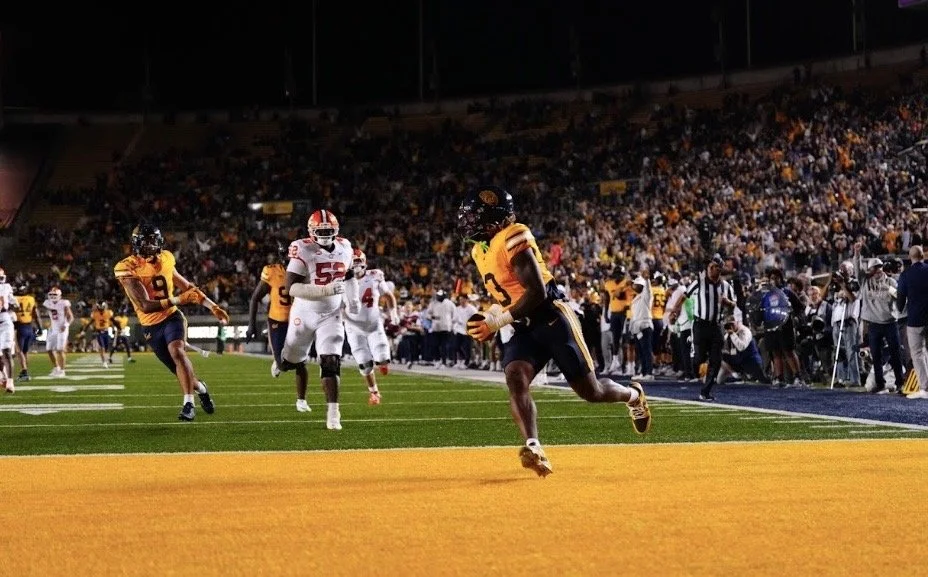
Photo by Celine Peiyi Zhong
After two straight, disastrous losses, Cal will face Virginia Tech this weekend in its homecoming game, looking to turn the season around. With the Bears entering their final five games as underdogs, this Saturday’s game is a crucial opportunity to change the direction of their season.
In the previous two games, Cal has made a habit of sloppy starts. Against Clemson Jaron-Keawe Sagapolutele (JKS) threw an interception on the third play of the game, and, while they came out hot against University of Nevada Las Vegas (UNLV) scoring a touchdown, they quickly gave up a 70-yard touchdown pass and a 55-yard rushing touchdown to the Rebels.
Cal’s strongest point this season has been their defensive prowess. They shut down Clemson’s offense for essentially the entire game, even scoring Cal's only touchdown of the night, a Kamar Mothudi scoop and score. Against UNLV, it was a different story. The Rebels dominated the Bears with seemingly big play after big play. Although Cal did have some helpful turnovers, allowing 39-points against a struggling UNLV offense tends to lose football games. However, outside of this game, the Bears’ defense has been impressive.
The Bears' offense, on the other hand, has been nonexistent. Highly touted quarterback JKS’s playing has not been on par to his freshman year standard, and it seems the offense as a whole has been unable to click. A clean pocket has been a rare sight for him, which often leads to already complicated plays being rushed. Against UNLV, the pressure appeared to have gotten to him, as his playing seemed rattled. In the first quarter, Cal’s special teams (who were on fire vs. UNLV) blocked a punt and set Cal up to be in a position to score. Two plays later, JKS threw an interception directly to UNLV defensive back, Quandarius Keyes, squandering a golden opportunity to score. Unfortunately, the lead-up to the second quarter held pain and panic for JKS as he received an alarming head injury, resulting in him being pulled for the remainder of the game. Following the injury, in came back-up quarterback Jackson Brousseau, who played a very impressive game, throwing for 200-yards and two touchdowns.
Cal’s offensive first halves have been extremely stagnant. Against Clemson, the time of possession was Clemson 19:12 to Cal 10:48, and against UNLV they went into halftime down 24-7. But in each of their games this season the team has flipped their switch for at least the third quarter. Against Clemson, the Bears came out fired up, putting together their best drive by far. This included their longest play of the night, a 26-yard throw from tight end Mason Mini. Still, Cal could not put the ball in the end zone, settling for a field goal, tying the game at 10-10. Against UNLV, Cal came out cooking, led by backup quarterback Jackson Brousseau, they scored a touchdown, two point conversion, and field goal all in the third quarter, then immediately scored a touchdown to begin the fourth quarter. Yet, in both of these games, Cal gave up two massive touchdowns to the opposing team, losing their grip on the game, dropping them to a disappointing two wins and three losses five games into the season.
These losses have raised serious questions about the Cal Bears. After what was supposed to be their best off-season in years, they are 2-3, and have barely scraped past two “bad” teams. Despite their dismal win-to-loss ratio, Cal’s defense has been electric, shutting teams down behind College Football's interception leader Kingston Lopa. While there is room for improvement in their run defense and tackling, for the most part, they have performed well. They’ve managed all this success with little to no help from the offensive side of the ball. Sometimes, the best defense is a good offense — this has not been the story for Cal.
Cal has scored 12 offensive touchdowns in 5 games, 6 of those coming from their game against FCS opponent Wagner. Looking only at their games against UCLA, Syracuse, Clemson and UNLV, Cal has scored six offensive touchdowns. Six offensive touchdowns in four games! This dysfunctional offense has caused doubt amongst fans as to where the team and coaching staff’s focus lies. We’ve heard a lot from Coach Tosh Lupoi in the media, but there has been little reflected in the team’s field play. He continues to try to fill up the stadium and generate money by doing things such as “taking the tarps off,” making Instagram edits, bringing concerts after the games and renaming the stadium. Cal even has a documentary out titled "Portal Games"; the documentary comes from NFL Films, and will give fans a behind-the-scenes look at Cal football's off-season and how they were able to retain quarterback JKS while also building a top 15 transfer class. Lupoi has been extremely successful in generating hype and getting attendance, but nothing generates hype quite like winning, which Cal has struggled at.
So the question remains: Is winning actually the focus for this team and coaching staff? Have these off-season antics been more distracting than productive? Are the coaches and staff focused on generating hype, talking to the press and building fame for the program, or are they focused on improving the team? The first five games of the 2026 season have shown two things. Winning a college football game is extremely difficult, and it may not be Cal Football's primary focus.
The other question is: where on earth is the offense? Cal had fewer athletic weapons and far less money last year, but were much more effective. Did quarterback JKS regress, and are the receivers actually not as good as fans initially thought? That, I believe, is not the answer. A Cal fan has been tracking JKS's throws and success rate through the first four weeks compared to last year, and the difference is glaring (ac_green33, 2026).
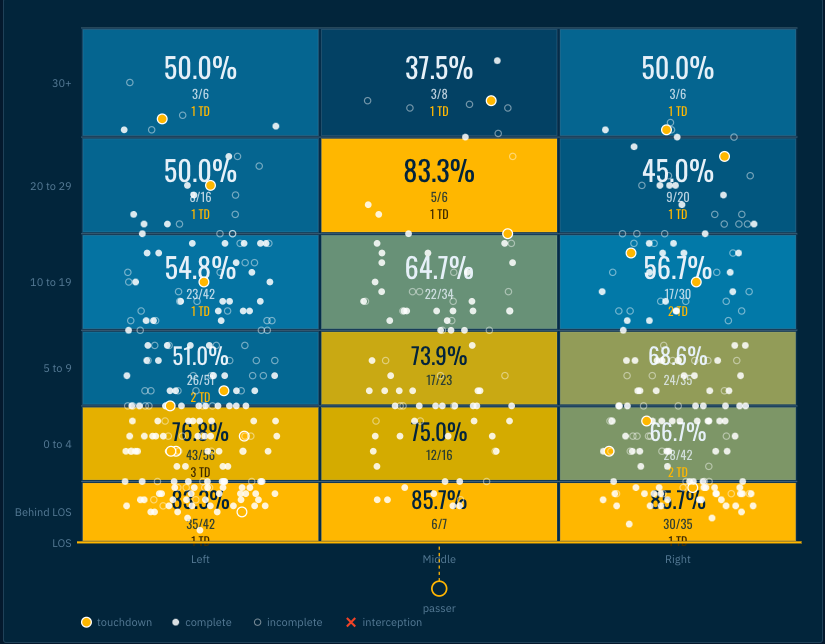
(Fig. 1) JKS’s freshman season
That year, he was elite at getting the ball down the field. One of his strongest throws last year was 20-29 yards toward the middle.
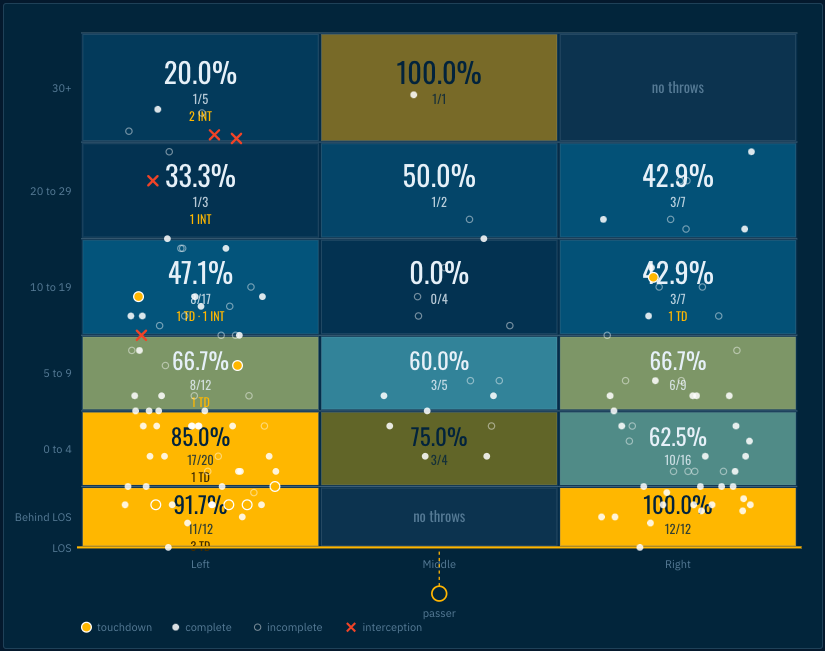
(Fig. 2) JKS’s current throwing chart
The numbers speak for themselves. His throws still have the same zip and accuracy; he just has not had the chance to showcase them.
Figure 1 is JKS’s freshman season. That year, he was elite at getting the ball down the field. He was efficient nearly everywhere, found sustained success in passes above 20 yards, and even dominated throwing the ball down the middle. Figure 2 is his throwing chart from this year; it shows inconsistencies and what feels like a lack of trust. One of his strongest throws last year was 20-29 yards toward the middle, and only once throughout this season's first four games has he completed a pass to this area, likely because it's only been attempted twice. The numbers speak for themselves; in every single area, statistically speaking, JKS has been worse at completing passes. This is not to fault the beloved quarterback, as he has been one of the few high points for Cal’s offense. His throws still have the same zip and accuracy; he just has not had the chance to showcase them. For starters, he has had very little time to make decisions after the snap; nearly every play, a defender is applying pressure, forcing him into rushed decisions that lead to incompletions or interceptions. Every so often, JKS pulls out his heroism, but plays take a while to develop, and the offensive line scheme has been unable to hold up.
Again, I beg the question: where does Cal's focus lie? During the off-season, they went out and recruited big-time wide receivers and flashy skill players but seemed to neglect the trenches and the fundamentals. Blocks are often left unfinished, players look tired, sometimes even bored or scared, and don’t play through the whistle. This doesn’t appear to be a talent problem, but something deeper, whether it’s coaching, culture, execution, or all of the above; it needs to be addressed if Cal wants to win football games.
There’s no one person to blame for this, as it is a team sport, but a strong candidate is first-time offensive coordinator Jordan Somerville who, just this week, has been relieved of his play-calling duties. The young coach has been around football for a long time, but has never actually called plays at this level. In an interview dating back to March 2026, he states that he has only ever called plays at the 12U level. Prior to Cal, Somerville coached at Arizona State University, University of New Mexico, University of Oregon, and most recently for the Tampa Bay Buccaneers. Often, coaches who work in the NFL and move to college football struggle to adjust, and it feels as if this could be happening to Somerville. The NFL game is far more complex, as it moves faster and the players execute at a higher level. Trying to implement an NFL offense onto a college team takes time and a higher level of football IQ, which no team in college football possesses.
Cal’s offense has been overly complicated, with many moving parts that the team struggles to follow. This has led to flags, interceptions, sacks, and an overall sense of disarray. Other questions arise about actual plays being called. Cal has continuously found themselves in third-and-long situations, on which they have been unable to convert. An example of this comes from the Clemson game, where instead of leaning on their star quarterback, they favored the screen pass play (a method which works, but rarely gains enough yardage for a first down). Screen passes take Cal’s best playmaker, JKS, out of the play and rely heavily on blocking, something which has been a weak point for the Bears. Then, there are plays such as the crucial third-and-one in the fourth quarter vs. Clemson. Instead of putting the ball in JKS’s hands, they sub in backup quarterback Dominic Ingrassia to run the play, and he immediately gets swallowed by three Clemson defenders. This all unfolds while the three-million-dollar quarterback JKS stands and watches from the far side of the field, left unattended and useless in the play.
Cal’s defense has been successful because of the combination of talent and coaching. Any viewer can see the talent, but it’s worth noting that defensive-minded Coach Tosh Lupoi has been putting the players in the right spots to be successful — as opposed to the offensive side of the ball, where the Bears obviously have the talent and tools to be successful, but are lacking the formula to put it all together.
Now, it’s easy for me to sit here and critique Cal’s coaching and their players, but it takes serious moxie to go out onto the field and play that game. Football is an extremely competitive, difficult, dangerous, and physically demanding sport. To win football games is no easy task. But, as a student, it is my responsibility to question where UC Berkeley as a whole and the football team is focused. Cal has put millions of dollars into football this year, a record-breaking amount for the school. Yet, the results have remained the same as previous years. If UC Berkeley is going to fund a program like this, it is understandable for students, alumni and staff to expect results. But I must reiterate that a program takes time to build, to expect greatness in the first year of the Tosh era was ambitious by Cal fans, but the least we can expect is effort, improvement, and action, something we have yet to see.
Cal looks ahead to a Saturday game against the 4-1 Virginia Tech. Last year Cal lost to Virginia Tech 34-42 in an overtime dogfight. Bears fans can expect different looks this week on the offensive side of the ball, especially with new play calling. We can only hope their defense can bounce back and continue their strong campaign. Virginia Tech is coming off a thriller loss to number 25 ranked University of Pittsburgh, 35-32. Both teams would benefit greatly from a victory, but a loss could be detrimental to both seasons.