Student Activism: A Response to ICE in the Bay Area
5 min read
On Wednesday, Jan. 28, 2026, students gathered outside Sproul Hall at the University of California Berkeley to protest Immigration and Customs Enforcement following the fatal shooting of Alex Pretti on Jan. 24. During the rally, organizers encouraged their community to attend a larger protest in San Francisco’s Dolores Park on Friday, Jan. 30.
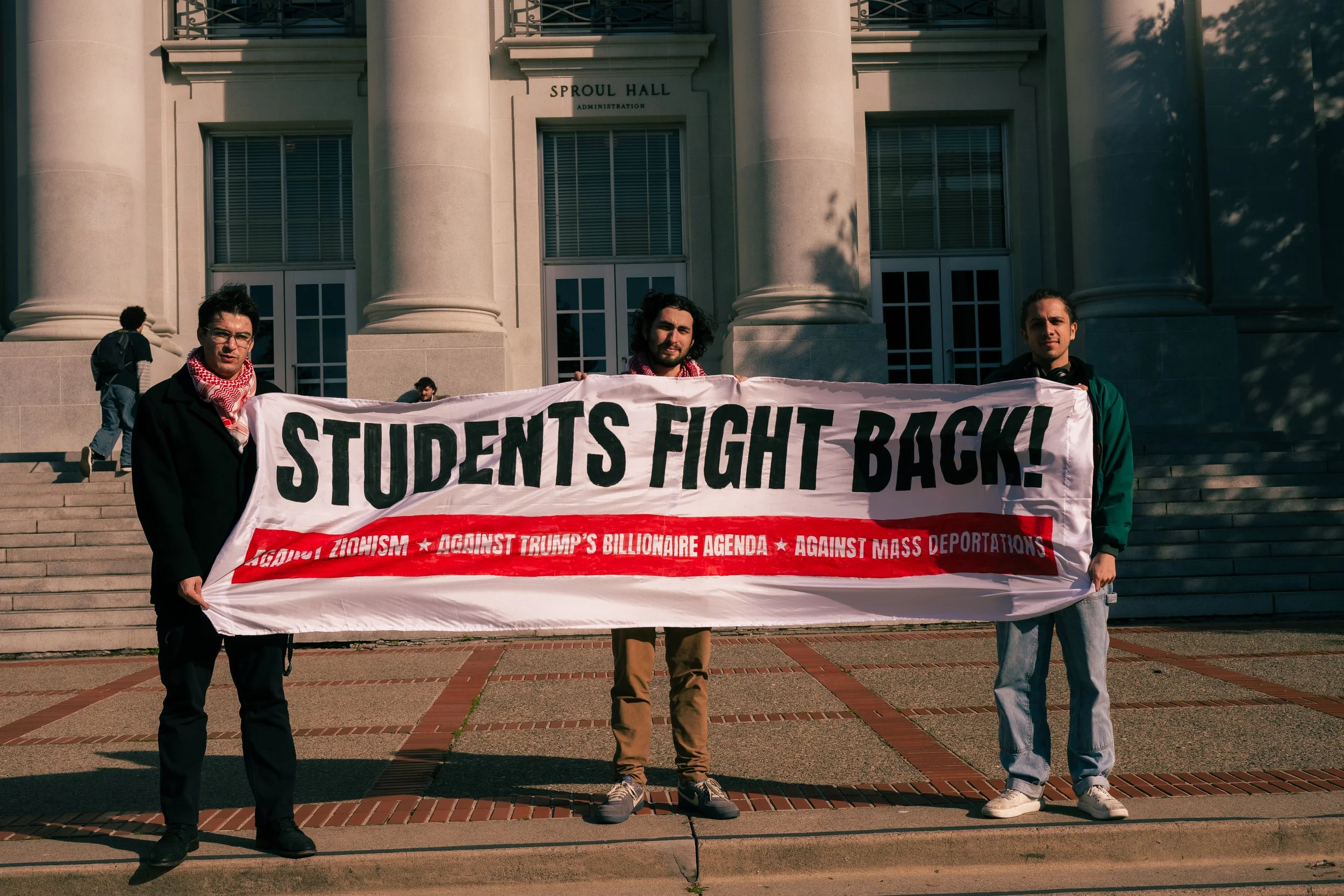
Students at UC Berkeley ICE protest. Photo courtesy of Mark North
Pretti’s death, alongside local and national injustices, have prompted nationwide protests, calling attention to brutality of ICE.
After ICE’s deadliest year in two decades under the direction of President Donald Trump in 2025, protestors have rallied to express themselves at the very university that birthed the Free Speech Movement in 1964.
One protestor named Russell Bates stood defiantly behind the speakers as he waved a “Free Palestine” flag, wearing a “Fuck ICE” shirt as he added to the texture of an already colorful gathering.
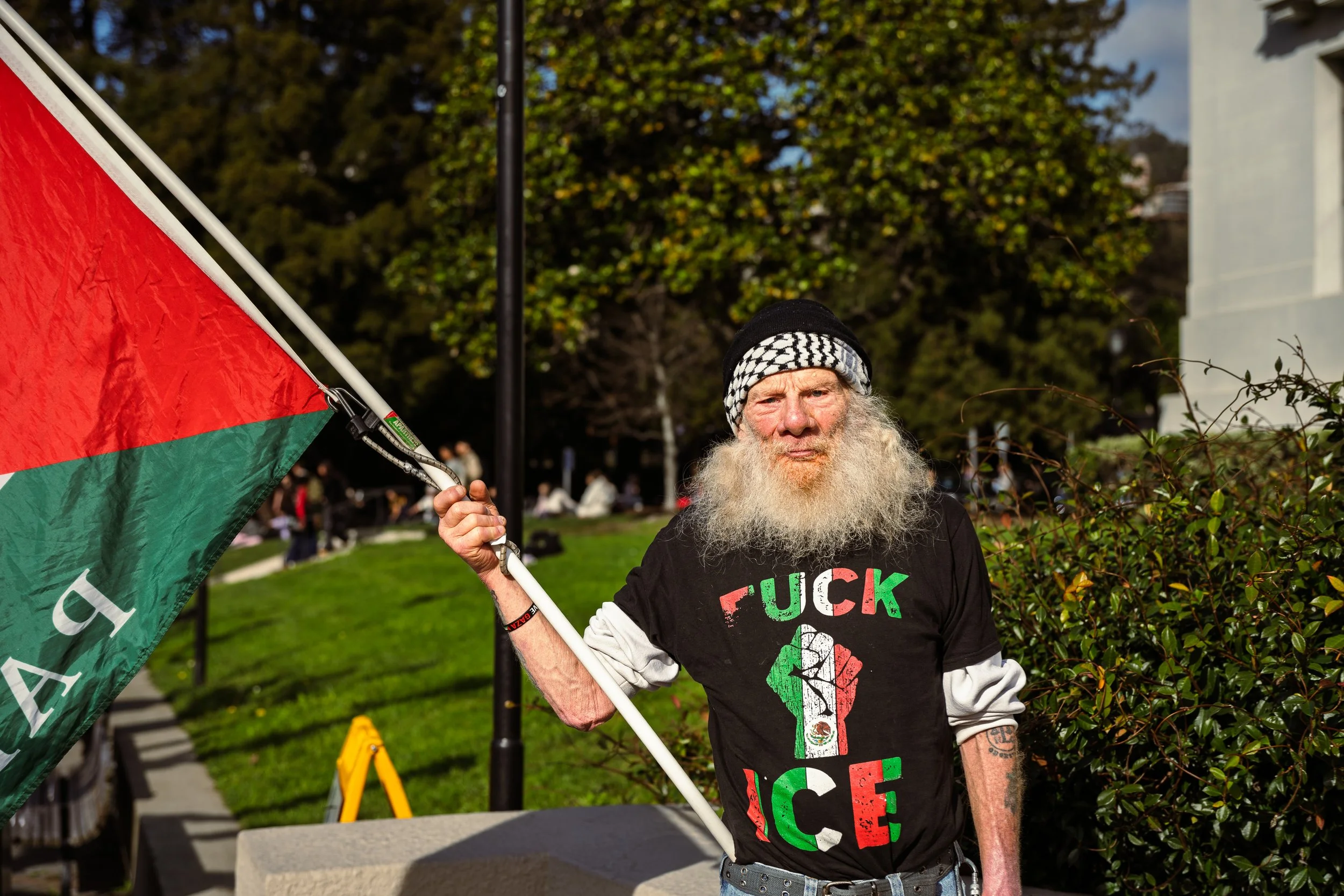
Russel Bates, protestor at Sproul. Photo courtesy of Mark North.
Bates was returning to activism from one of his many hiatuses throughout his life “I’m recovering from burnout,” he said. “I’ve had to self-isolate for some time and let everything sink in.”
Alex Pretti, a 37-year-old intensive care nurse for the United States Department of Veterans Affairs, was the second U.S. citizen to be killed by federal forces in Minneapolis at the start of 2026.
His death was beyond the final straw for many Americans who have been voicing their concerns over the unethical use of federal services exacerbated by the presidency of Donald Trump — whose campaign was fueled by anti-immigration rhetoric.
Bates is among the many others who feel disillusioned at the deployment of federal agents in their streets.
After being arrested about 40 times and feeling the effects of constant police altercation, Bates admits, “I reached a point where I just couldn’t do it anymore.” But after his break from the grueling field of activism, Russel felt it was necessary to return.
“It turned out that activism was what was keeping me going,” he said. “There are so many ways to take action.”
Say Their Names
Another protester named Jonathan was quick to identify his motivations on Sproul Plaza.
“I’m here just letting my voice be heard, ” he said. “I’m joining my community and standing up for what’s right.”
Jonathan was dressed in a black and silver jersey with an upside-down American flag, holding a sign which said “Justice for Keith Porter.”
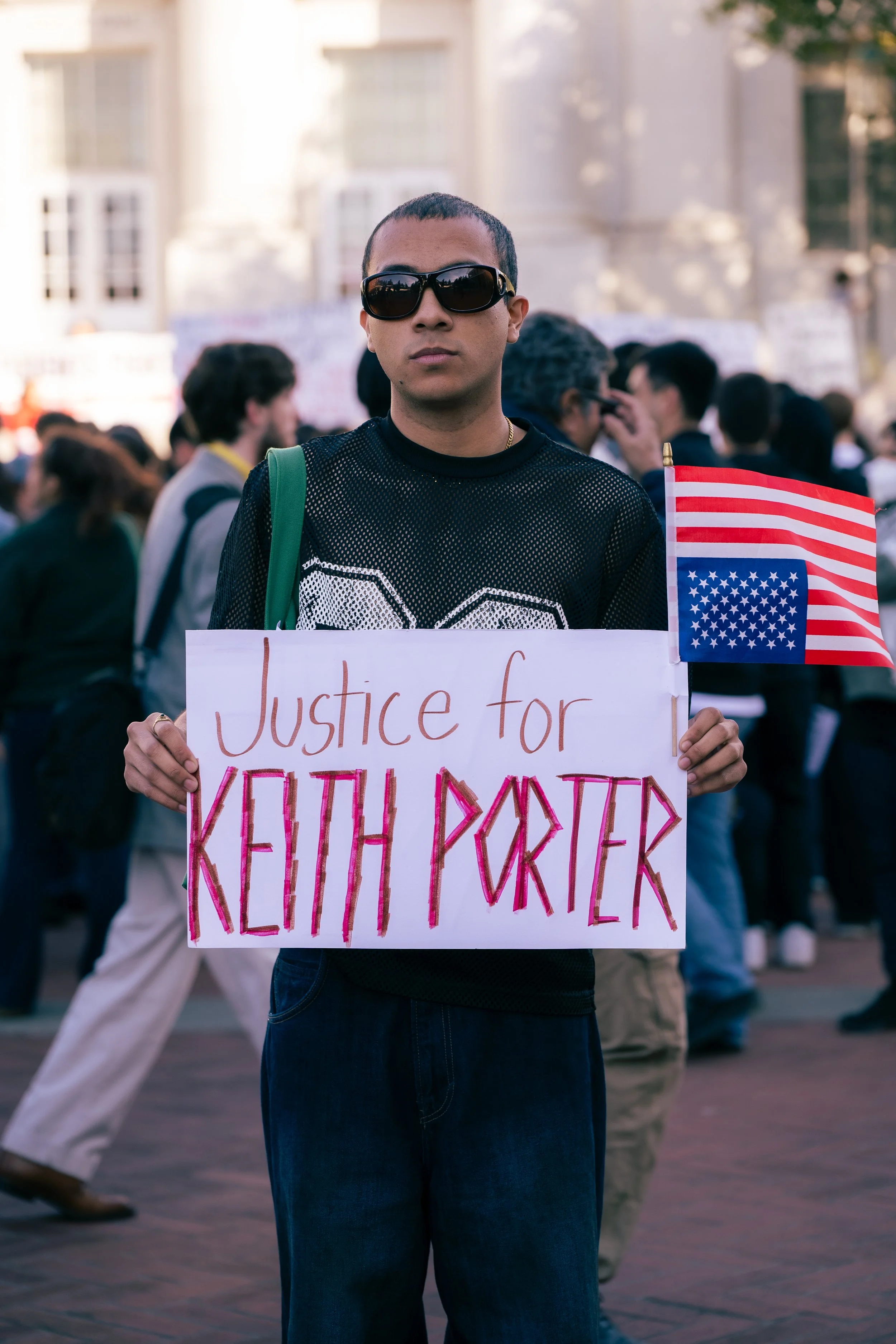
Jonathan, a student protest at Sproul. Photo courtesy of Mark North.
Porter, the uncle of one of Jonathan’s closest friends, was fatally shot by an ICE officer on New Year’s Eve, after firing “gunshots into the air,” according to an LAPD spokesperson.
“He was a U.S. citizen,” Jonathan said. “Nothing about his actions had to do with immigration or anything that would call for ICE involvement. It was completely unnecessary and uncalled for.”
Jamal Tooson, an LA attorney representing Porter’s family, said Porter’s actions may be grounds for LAPD citation, but the off duty ICE agent subjected him to “a death sentence.”
Jonthan said this situation is a “clear demonstration of police brutality and unchecked powers,” urging others not to “overlook and allow [this] to continue in our country.”
As the demonstration on Sproul was nearing to an end, with speakers urging the students to take action and attend the Friday protest at Dolores Park, Jonathan encouraged students to protect their communities.
“Let their voices be heard through their actions,” he declared.
Friday at Dolores (Emilio Carmonascheker)
I wasn’t there when an ICE agent in Minianopolis strewed bullets into Renee Good’s driver-side window, killing her as she attempted to flee in her vehicle.
I couldn’t hear the ten separate gunshots that rang out when another ICE officer killed Alex Pretti, firing bullet after bullet into his body as he lay defenseless on the ground.
However, I was there at Dolores Park in San Francisco on January 30th, 2026 when I, amongst thousands of other constituents, marched in protest of the recent killings and overall abuse of power committed by the U.S. Immigration and Customs Enforcement.
This protest in the Mission District of San Francisco was one of many that occurred nationwide that day, along with the countless other demonstrations that have taken place over the recent years. Good and Pretti showed up to protest the injustices that have long been committed by ICE, and we showed up to protest the very same thing.
The difference for us on January 30th was that Good and Pretti were added to the list of victims of ICE’s brutality.
As of February 10th eight people have died in the new year, either by direct confrontations with ICE agents or during their detention under the agency, which has been thoroughly supported by President Trump and his administration.
The “Debate”
There is much to say on the matter.
The plethora of sociopolitical implications deriving from this issue are daunting, and the people of our nation, whether “documented” or not, can debate endlessly over them.
We can discuss the fine details regarding the differences between political protests, riots, civil disobedience, and overall civil unrest in response to this crisis. We can debate on what would quell this unnecessary conflict between the state and its people. We can delineate to one another where the line is drawn.
However, the common denominator of these discussions, debates, and delineations is death–death by the government.
Beyond the killings committed by ICE, as well as the deaths that have occurred under their detainment, we are protesting the overall implementation of the U.S. Immigration and Customs Enforcement.
It has been abhorrent, to say the least.
The Necessity
Let us take a step back; not to discuss, debate, or delineate the issues surrounding the killings committed by ICE, but to make clear what most of us would see as the purpose of ICE to begin with.
From a perspective that would seem to be neutral, I am inclined to believe that most politically moderate people who subscribe to this nation’s overarching structure would agree that “Immigration and Customs Enforcement” may be a necessary agency for any nation.
This, of course, is assuming that due process is involved and killings are not being committed by said agency. Nations in general have certain mores, folkways, and laws. As a citizen or resident of a nation, it is reasonable to expect some sort of administrative or bureaucratic body to regulate who enters and leaves the nation.
In theory, this process is intended to protect the people of a nation, as well as to maintain the social and political climate. With this general assumption in mind, no reasonable person is opposing the deportation of actual criminals, terrorists, and the like.
Where Immigration and Customs Enforcement goes wrong in the U.S. is through the total lack of restraint and oversight on its agents. There seems to be a certain complex that these agents hold; one that bears no mind to the human rights of those they are ordered to regulate.
This is clearly a significant issue considering that human rights are what should be at the forefront of ICE’s practices. After all, human rights should be at the forefront of all our practices.
The Bottom Line
So, let me make clear what I believe to be the reason many of us have shown up and showed out: If ICE is truly a necessary agency, it is blatantly obvious that ICE is not doing its job correctly (to say the absolute, very least).
People are being killed by ICE or dying under their detainment in staggering numbers, and ICE is not representing the attitudes or beliefs of the people.
With this in mind, I can only speak for myself.
Certainly, there are people who are opposed to any form of immigration and customs enforcement, but something that their view and mine have in common is that we can agree that ICE is not doing its job (whether it is viewed as necessary or not).
ICE is representing a threat to the people and social fabric of this nation. It is incumbent upon anyone who values human life to take a stand against the administration of this agency. Get out there and take that stand.