
Why Not Cal? Patrick Laird on Alignment, NIL, and the Moment Facing Cal Athletics
4 min read
ALUMNI SPOTLIGHT — Former Cal running back Patrick Laird explains why leadership alignment, institutional belief, and cultural clarity could redefine the future of Cal football and the university as a whole.
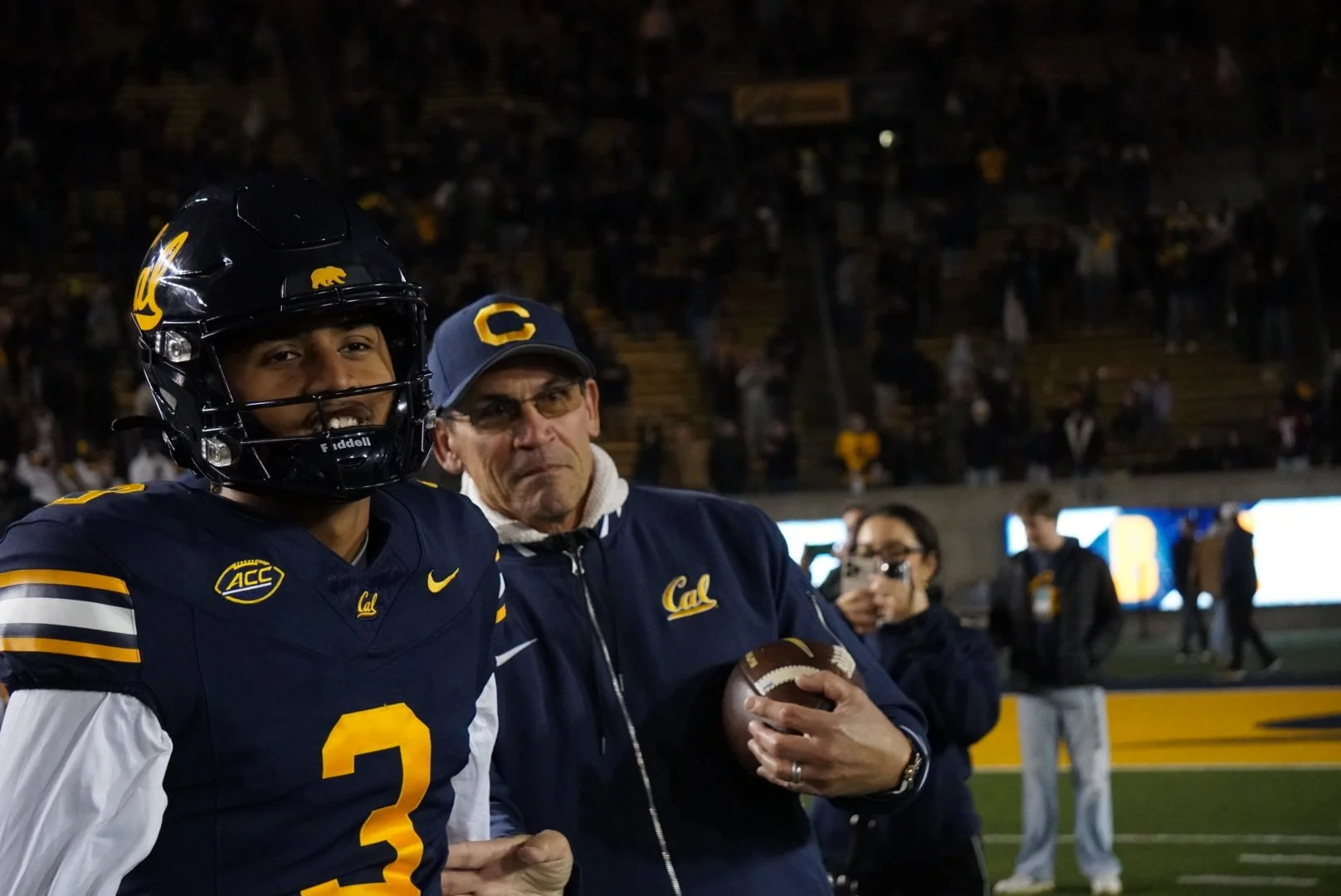
Cal GM Ron Rivera with starting quarterback, Jaron-Keawe Sagapolutele following their final regular season game of 2025, vs. SMU. Photo courtesy of Morgan Garcia.
Patrick Laird is careful with absolutes. But when he talks about the current moment in Berkeley athletics, his tone sharpens.
“This feels like the time,” he says. “Why not Cal?”
For Laird, that optimism is rooted in alignment — something he believes has been missing for much of the past decade, both institutionally and culturally.
Football as the Front Porch
“Football is the front porch of your athletic department,” Laird says, echoing a phrase often used by Ron Rivera. “If that porch looks neglected, outsiders assume the whole house is.”
The current moment, Laird says, is defined by leadership alignment: Chancellor Rich Lyons, a Cal alumnus; Ron Rivera, a former Bear now serving as the program’s general manager; and head coach Tosh Lupoi, who also played at Berkeley.
Cal’s Olympic sports, like swimming, water polo, golf, rugby, have long dominated nationally. But football shapes external perception.
“That clouds how people see the entire program,” Laird says. “Fair or not.”
NIL, Timing, and the Wilcox Era
Laird is quick to defend former head coach Justin Wilcox, who coached Laird in his final two seasons in Berkeley.
“He was never aiming for six-and-six,” Laird says. “People forget that.”
Wilcox’s early seasons showed progress, especially with an 8—5 season in 2019. Then came COVID.
“Cal football probably faced more restrictions than any program in the country,” Laird explains. “You can’t just restart where you left off.”
When NIL arrived, the gap widened.
“Other schools had alumni ready to throw cash immediately,” he says. “Cal was behind the ball.”
Laird is careful not to frame NIL as a cure-all. The system, he notes, has introduced volatility across college football, rewarding programs with established donor bases while straining others. At Berkeley, the challenge has been finding a model that preserves academic identity while remaining competitive in a rapidly shifting landscape.
Wilcox, Laird says, focused on culture-building — leadership councils, team-building sessions, and football education that prioritized long-term cohesion. Laird also mentions his open-door policy to the media, creating a program that teaches the basics of football.
“That stuff takes years,” Laird says. “And the transfer portal compresses that timeline.”
Why Alignment Matters Now
With donor investment increasing and NIL infrastructure beginning to stabilize, Laird sees the current moment as a rare convergence where institutional belief might finally match ambition.
He frames it not as a guarantee of success, but as an opportunity that Cal has rarely had in recent years.
“Donors want to invest when they see a clear plan,” he says. “Alignment gives them confidence.”
When Ron Rivera took over as the general manager of the Cal Football team, appointed by Chancellor Lyons, he pitched his vision to potential donors. This vision was one of the alignment between Cal’s academic and athletic success — a place where culture breeds the brightest minds.
At Cal, he argues, difficulty is not a flaw but a differentiator.
“At Berkeley, nothing is handed to you,” Laird says. “But if you make it here — academically and athletically — you’ve got a story no one else has.”
Culture as a Competitive Advantage
Berkeley’s academic rigor has long been framed as a recruiting obstacle. But Laird sees it differently.
“If you want easy, Cal isn’t for you,” he says. “But if you want to grow—this place shapes you.”
That’s why leadership and the emphasis on rebuilding a culture is so important.
“You need people who lived it,” Laird says. “Who understand the challenges and reframe them as strengths.”
Pulse Takeaway: Tosh’s Timeline
Laird doesn’t promise championships. Nor does he guarantee wins.
But he believes in moments.
“This is the time to invest,” he says. “In people, in culture, in belief.”
As head coach Tosh Lupoi takes over the program from Justin Wilcox, the expectation is change. No one can guarantee a particular result in the win column, but the current look at Cal’s recruiting efforts can convince the fan, or student, or alumnus, that things are changing. . . for the better. . . in Berkeley.
For Laird, the question isn’t about guarantees, but about whether Berkeley is finally willing to bet on itself.
“Why not Cal?”