Selective Outrage: Why Berkeley Students Challenge the Past but Hesitate in the Present
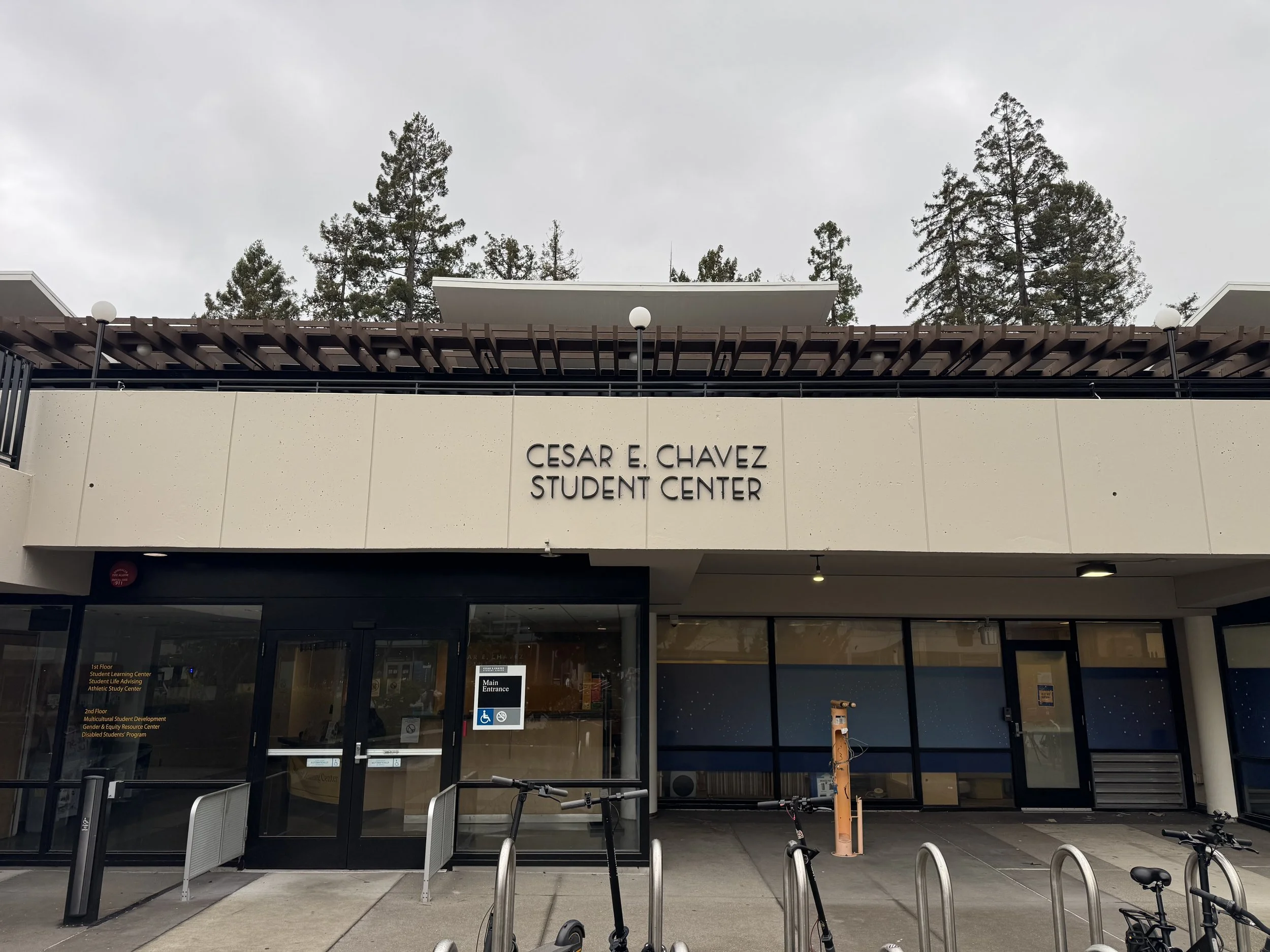
In response to renewed public criticism of Cesar Chavez, faculty in Berkeley’s Social Sciences and Chicanx Latinx Studies departments have voiced support for the university’s ongoing review of the Cesar Chavez Student Center building name.
This reassessment reflects broader conversations about how institutions commemorate historical figures whose legacies are increasingly subject to scrutiny.
The current debate has been intensified by a recent New York Times article that presents serious allegations against Chavez, including claims of sexual abuse of minors and the exploitation of women. The reporting has also drawn attention to statements by American Labor Leader, Dolores Huerta, who accuses Chavez of sexually assaulting her in the 1960s, impregnating her twice as a result, and later leading her to arrange for both children to be raised by other families.
While these allegations remain a subject of public discussion and have prompted strong reactions across communities, they have also led some faculty and students to call for a careful and transparent evaluation of the historical record.
Supporters of the review process emphasize the importance of aligning campus symbols and names with the university’s values, particularly in light of evolving understandings of justice. At the same time, the issue remains complex, as Cesar Chavez has long been recognized for his role in labor union organizing and civil rights advocacy.
For many, this moment represents not only a reassessment of an individual legacy, but a broader effort to navigate how institutions engage with contested histories in a responsible way.
The impulse to question should be encouraged. No person, no matter how respected, should be immune from scrutiny. However, the inconsistency in how scrutiny is applied reveals that accountability is often driven less by principle and more by convenience.
What is more concerning, is not that students are willing to challenge the past, but that they are often far less willing to confront the present.
While campus erupts in debate over the legacies of those long dead, the response to powerful, living figures–those of who are actively shaping policy and people’s lives–feels quieter. And that raises an uncomfortable question:
Why is it easier to protest history than power?
Part of the answer is simple: the past is safe.
On a campus like UC Berkeley, where challenging the status quo is embedded in the culture, and activism operates as a kind of social currency; you’d expect outrage to be consistent, principled, and fearless.
Instead, it is often selective.
There is no real risk in condemning someone who can no longer respond or retaliate. No internship will be lost. No professor will be offended. No doors quietly closed. Outrage directed at historical figures carries moral weight at very little personal cost.
Confronting the present is different. It is messy, politically charged, and often unclear. Allegations involving current leaders require a willingness to sit with discomfort and uncertainty. Challenging those in power today carries real risks: social backlash, professional consequences, and the likelihood of being dismissed as “partisan” rather than principled. Too often, judgment becomes filtered through political loyalty, with actions defended or condemned based on party affiliation rather than held to a consistent standard.
So, instead, we gravitate toward what is easier to agree on.
We rename buildings. We debate legacies. We post statements about figures whose stories are already distant enough to argue about, but distant enough to feel abstract. In doing so, we create the illusion of bold activism without necessarily engaging in the kind of advocacy that challenges current systems of power.
This isn’t to say that revisiting history is meaningless. It matters. Symbols matter. The names we honor reflect the values we choose to uphold. However, if activism only begins and ends with symbolic correction, it risks becoming performative, instead of meaningful.
The contrast becomes even more uncomfortable when we look at how allegations against current leaders are treated.
In recent years, several of the most powerful figures in the American government have faced serious allegations of sexual misconduct, highlighting broader concerns about accountability among those in positions of power.
President Trump was found liable for sexual abuse in a civil court; Secretary of Health, Robert F. Kennedy Jr. has acknowledged having “skeletons in his closet” in response to a 2024 sexual assault allegation. Other prominent figures, including former president Bill Clinton, current Secretary of Defense Pete Hegseth, former New York leaders Eric Adams, and Andrew Cuomo have also faced allegations.
These cases span political affiliations, making clear that this is not a partisan issue, but a systematic one that raises critical questions about responsibility and consequences at the highest levels of government.
These allegations, no matter who they involve, should call for the same kind of moral clarity that students demand of historical figures.
But that’s not what usually happens.
Instead, the response is uneven. Language gets softened and advocacy starts to depend on who’s being accused. It is far easier to reach consensus on the past than to take a stand in the present, where speaking out can carry real social and professional risks. If accountability is only pursued when it is convenient, it ceases to be accountability at all and instead becomes performance.
If we are willing to question the morality of those who came before us, we should be equally willing–if not, more so willing–to scrutinize those who hold power now. Not selectively. Not when it’s convenient. Not only when it aligns with our existing beliefs.
Because justice that seeks only to rectify the past is incomplete.
So, I propose that we create a campus-wide standard for accountability; one that is not tied to political partisanship, ideology, popularity, or convenience but rather a joint initiative by both students and faculty that commits to evaluating allegations and abuses of power through the same lens, no matter who is involved. A space where consistency is required, biases are challenged, and true advocacy is supported rather than selectively or performatively encouraged. This could take the form of an open forum series at Sproul Hall, a cross-organized coalition–something that forces us to confront not just what we believe, but how consistently we apply it.
Berkeley has never been a campus known for silence. Its identity is rooted in challenging authority and pushing uncomfortable conversations into the open. But as students we must ensure that our activism is not just loud, but also honest and free from bias or favoritism
Fairness doesn't just happen passively. It has to be built, protected and practiced.
So let's build it.