Protest First, Learn Later: Berkeley’s Culture of Moral Certainty
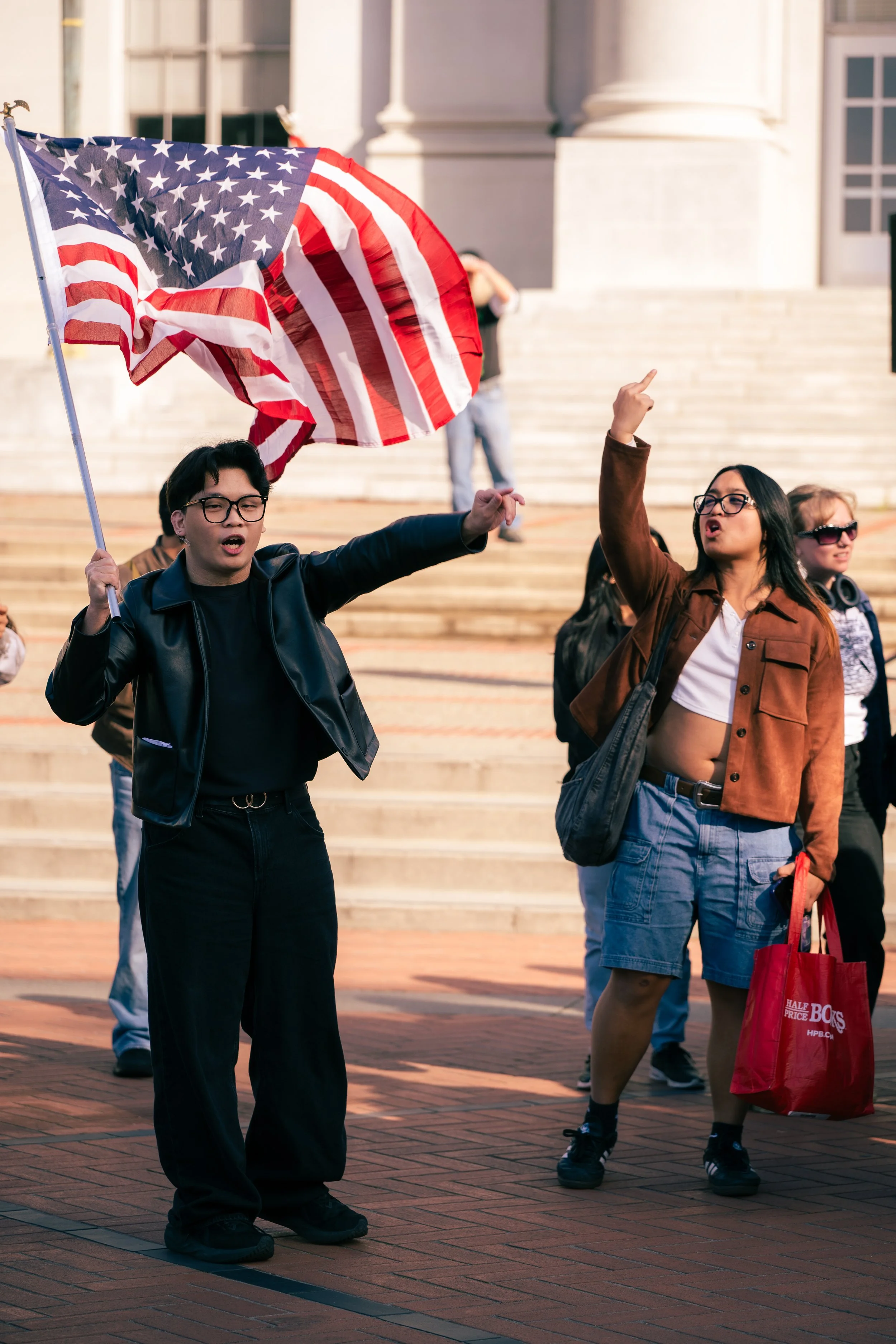
Photo by Mark North
A Campus Built on Protest
At UC Berkeley, protesting is not just common, it is cultural.
Walk through Sproul Plaza during almost any week of the semester and you are likely to encounter it: a rally about immigration, a march criticizing US foreign policy, students chanting about conflicts overseas, or a demonstration responding to the latest political controversy.
Posters appear overnight. Instagram slides circulate, compressing complex histories into five digestible frames. Within days a movement takes shape, only to disappear just as quickly as it arrived.
A Legacy of Activism
Berkeley students inherit a legacy of activism. The campus was the birthplace of the Free Speech Movement in 1964 and a central hub of protest during the Vietnam War. Generations of students have come to Berkeley not simply for its academic excellence, but as a place where political consciousness is expected to be expressed.
That legacy matters. Protest has historically been one of the most powerful tools Americans have to challenge institutions and demand accountability. But something about the current campus protest culture feels increasingly disconnected from the purpose of a university.
The problem is not that Berkeley students protest. The problem is that many students protest before they understand what they are protesting for.
Activism at the Speed of Social Media
In the past year alone, campus demonstrations have erupted over issues ranging from the Israel-Palestine conflict, to immigration enforcement, US involvement in the Middle East, and most recently American military action against Iran. Students mobilize quickly. Within hours of a global event, social media is filled with posts urging people to “pick a side.”
And students do.
But the speed with which these positions form often leaves little room for something essential: context.
Many of the global conflicts that dominate campus protests are the result of decades or often centuries of complex historical developments. Understanding these dynamics not only requires patience but requires time to learn history, examine multiple narratives, and confront the uncomfortable reality that conflicts rarely divide neatly into heroes and villains.
Yet the modern protest environment, especially in the age of social media, tends to favor quick expressions of moral clarity.
Platforms like TikTok and Instagram compress complex political realities into emotionally persuasive narratives designed to capture attention quickly. A conflict debated by historians for decades becomes a one-minute video or a handful of slides.
The result is a form of activism that sometimes resembles a reaction more than an intellectual position. Students come across a narrative, feel its urgency, and move directly to protest without the necessary step of study.
The Pressure to Pick a Side
Perhaps the most striking feature of today’s campus activism is the expectation that every political issue must have a single morally correct side.
To express uncertainty can feel like a moral failure. To acknowledge complexity risks being interpreted as betrayal.
But the reality of many conflicts–especially international ones–is that multiple truths often coexist.
Israel-Palestine and Competing Narratives
Take the Israel-Palestine conflict, one of the most polarized issues on Berkeley’s campus. Students often approach it through a framework that assumes a clear moral binary.
The history is far more complicated.
Jewish historical memory includes centuries of persecution in Europe culminating in the Holocaust, which killed six million Jews and profoundly shaped the push for a Jewish state. For many Israelis, Israel represents safety and survival after generations of statelessness and violence.
At the same time, Palestinians experienced the creation of Israel in 1948 as a catastrophe, “the Nakba” during which hundreds of thousands were displaced from their homes. Many Palestinian families still carry memories of their lost balads (towns and villages), refugee camps, and decades of military occupation.
Both narratives are real. Both histories shape how people understand the present.
Yet campus discourse often pressures students to accept one narrative while rejecting the legitimacy of the other. The idea that two populations can carry legitimate historical trauma and both deserve dignity often struggles to find space in protest environments built around slogans.
This pattern extends beyond Israel-Palestine. It is applicable in all campus wide conversations.
Political movements often rely on simplified narratives to mobilize support. But when those narratives dominate a university environment, they risk replacing inquiry with ideology.
The Role of the University
The irony is that universities exist precisely to challenge intellectual shortcuts.
Higher education is meant to slow thinking down, not speed it up. It encourages students to examine sources, compare perspectives, and recognize how history shapes political realities.
A university should be the place where students feel comfortable saying, “I don’t fully understand this yet.”
But in today’s protest culture, that humility is often absent. Students can feel pressure to adopt fully formed political positions on extremely complex issues within days of encountering them. The social cost of uncertainty can feel high.
Yet genuine understanding requires willingness to sit with complexity.
Reconnecting Protest and Learning
None of this means Berkeley students should stop protesting. Protest has played an essential role in American history. Berkeley’s identity as a politically engaged campus is something many students rightly value.
The issue is not activism itself.
The issue is when activism becomes detached from the intellectual mission of the university.
Imagine if every major demonstration on campus was paired with a teach-in led by historians, political scientists, and scholars. Imagine if protest organizers invited speakers representing multiple perspectives on a conflict.
Imagine if students felt encouraged not only to chant slogans, but also to ask difficult questions.
Intellectual Humility
Perhaps the most radical shift Berkeley students could make is embracing intellectual humility as part of activism.
This does not mean abandoning moral convictions or stances. It means recognizing that conviction should be informed by study.
In a polarized political climate, the willingness to hold complexity is increasingly rare. But it is exactly what a university education should cultivate.
The Future of Berkeley Activism
Berkeley has long prided itself on producing students who challenge the world around them. The next step may be learning how to challenge our own certainty as well.
Because the most meaningful activism is not just loud.
It is informed.
And if Berkeley truly wants to remain both an activism-based university and one of the world’s leading academic institutions, the two must go together.
Sometimes the most intellectually honest response to a complex conflict is not a chant.
It is a question.