The Modern Protester’s Uniform
5 min read
Fashion, as seen in the past, serves many uses beyond the realm of beautification and appearance. Statements are made through what we choose and choose not to wear on a personal and global level. Inversely, fashion itself has been defined by what we choose and choose not to follow.
For example, the peaceful hippy style resonates with the anti-war sentiment of the 60s. The D.I.Y. (Do It Yourself) punk style continues to reflect its anti-establishment origins. Even Y2K fashion holds roots in the grunge ideal of authenticity and personal expression – which would ironically be capitalized on twenty years later.
These effects of fashion can still be seen today in Berkeley on Telegraph Ave., where artists continue to make pieces that reflect these styles. Whether it be handmade jewelry or custom jackets, the movements of the past are still here. Regardless of whether the wearer believes in the designer's ideals or not, these movements were made uniform through a physical style that represented groundbreaking ideals.
Today, however, the fashion of modern movements has become more influenced by safety than ideals. Over the past decade, we have witnessed thousands of demonstrations around the world all backed by major movements. Despite the variety in their cause, we can see one item continue to be worn by protesters everywhere: face masks.
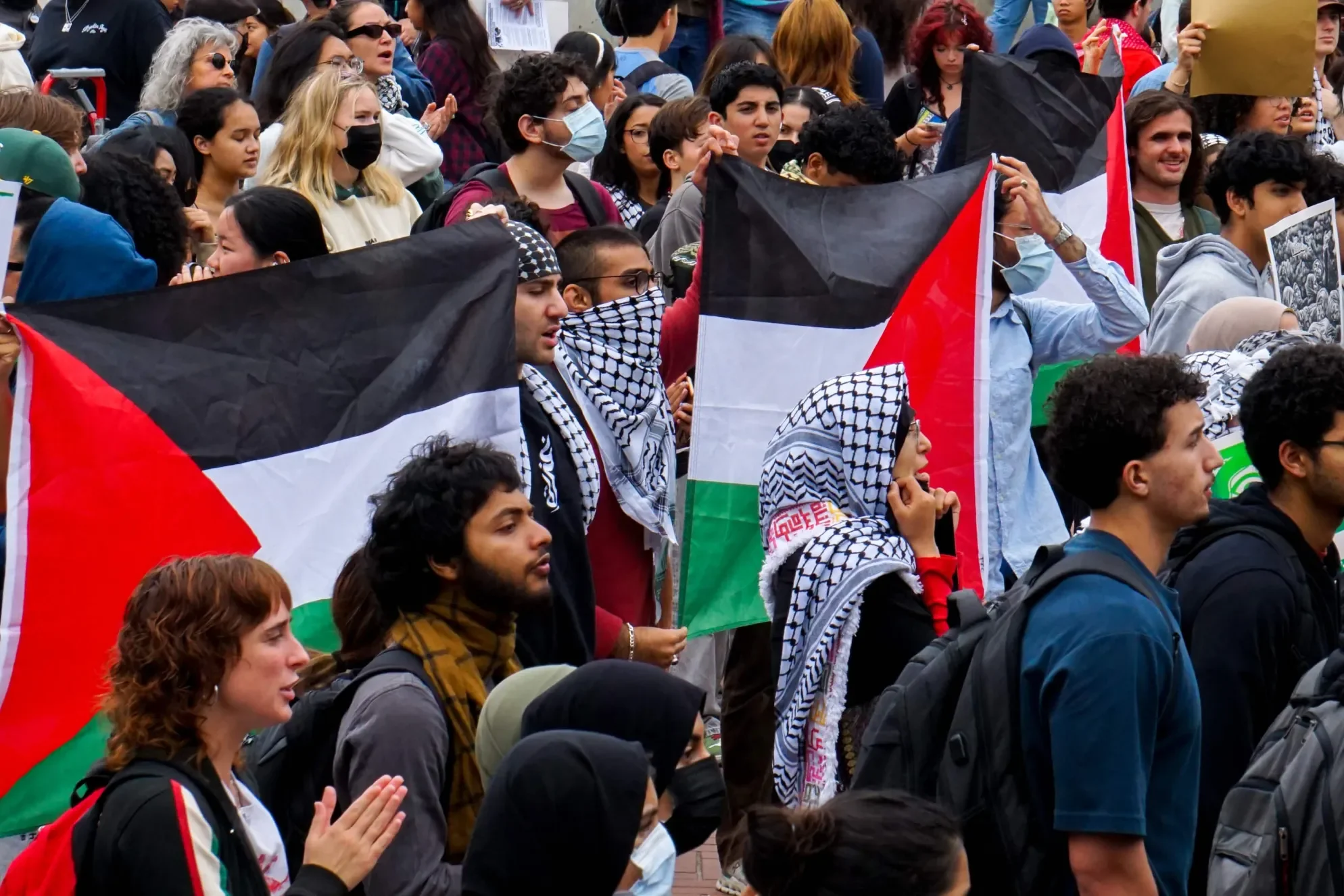
Free Palestine Protest, Berkeley, October 8th, 2025. Photo courtesy of Noah Medieta
Though it would make sense for this trend to begin in 2020 following the Covid-19 pandemic, it dates further back to China in 2002. The SARS outbreak made the usage of face masks across the country common. Although face mask use in protests wouldn’t see an uptick until the 2010s: normalization of wearing face masks had begun.
Hong Kong set a new precedent in 2014 with the Umbrella Movement, where protesters brought umbrellas to their demonstrations as a means of protection against tear gas and pepper spray. More importantly, face masks were utilized to defend themselves where the umbrellas could not. Umbrellas still have some presence in protests today, but face masks remain a staple piece for Hong Kong protests.
The following five years, masks had little use outside basic physical protection. Upgrades were even seen with ventilators and goggles, which almost entirely counteracted the effects of the chemical agents. That was until 2019 when, once again, Hong Kong held massive demonstrations against their government.
This time, a new threat was raised as CCTV cameras were used to identify protestors. Masks were no longer optional; masks were essential for identity protection. But masks weren’t enough. In order to be completely unidentifiable, protesters had to work together to blend in with each other. Black clothing, masks, and sunglasses became the uniform of their movement.
Although their movement was ultimately suppressed widely due to the Covid-19 pandemic, it served as a valuable learning experience for the Western hemisphere. The trend of masked demonstrators quickly resurfaced in the U.S. and other Western nations in 2020 out of similar fears.
Police have continuously used both tear gas and pepper spray to subdue demonstrations. Protesters are identified by law enforcement through video footage and online circulation. No matter what the protest is, these threats transcend nations.
As said before, protester fashion was generally a product of ideology rather than necessity. So, unlike the so-called hippies or punks, we’ve now entered an age where dozens of ideologies can wear the same uniform.
Can we therefore deem masks to be a part of any singular movement?
The answer is nuanced.
The protesters who fear the threat of identification, face government agencies with the same fears of being identified. The Hong Kong protests of 2019 faced law enforcement with ventilators which conveniently hid their identity. Immigration and Customs Enforcement agents today have notably worn gators to intentionally hide their identity from the public. Masks therefore give an equal power of defense to government agencies that protesters fight against.
Therefore, the most compatible answer is that this style is not part of a movement, but an era. If government agencies can face the same threats as their protesters, they are no longer just opposing forces; they are both subjects to the era of identification.
We will therefore not see a decline in the use of identity concealing style on either side. Unless technology regresses with AI and drones, and with increased video presence, these factors will only continue to force everyone to value their identity more.
However, for the sake of unity, we can see one significant difference that keeps the two groups separate. The key difference between these is that governments have more power to use identification as a means of subduing movements. In this sense, all protesters who have used masks to protect their identity from government agencies have something in common. They are unified by the fear of their government’s power.
The use of masks is therefore the fashion of the oppressed.